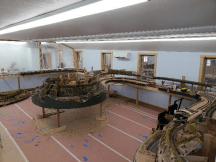
3 Months After Beginning the Move

12/8/20

This progress report will be mostly captioned pictures to catch up on other work going on at the club.

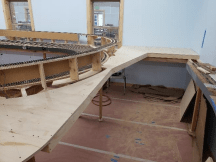
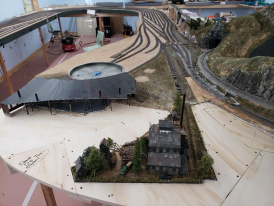
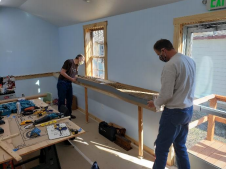
 Framing for paper mill and chip yard at the end of  the Eagle Cove branch. That’s the NW corner of the new  train room 

Doug added sheathing to the mill and chip yard

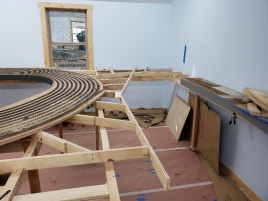
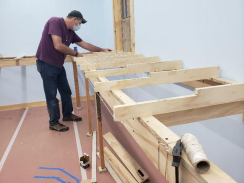
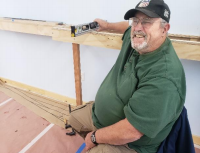
 George begins L girder work for south room center peninsula. Notice how they are built right over the full size drawing 

George continues L girder work. Notice free standing portable L girder to the left.

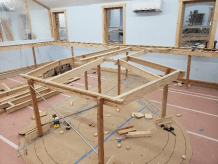
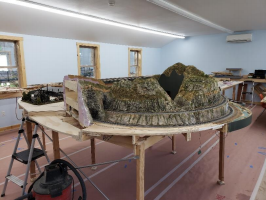
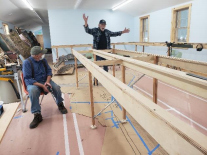
Completed L girder array for center peninsula

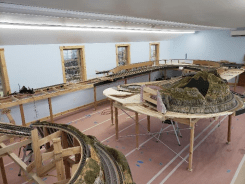
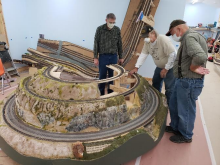
Layout chunk atop L girders and it FIT

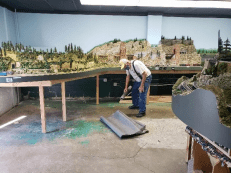
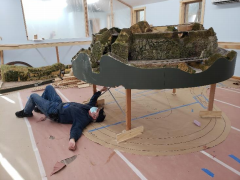
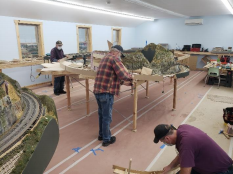
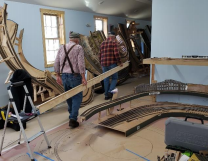
Gene taking down the layout skirt 3 months ago. We’ve made exceptional progress in 90 days: documenting, cutting apart, transporting, re-building.

The 4th Law of Physics

12/8/20

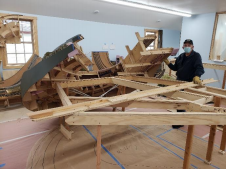
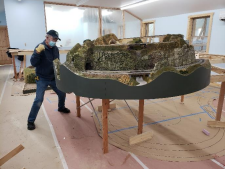
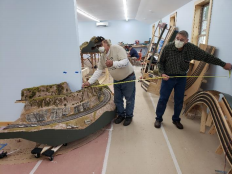
Some of you know I used to teach physics.  Today Doug Taylor and I used all 3 of Isaac Newton’s laws of physics and invented a fourth.  In addition to Big Ike’s laws of inertia/momentum,  force mass and acceleration, and equal and opposite forces, we invented a fourth. That is to  say that if it doesn’t WANT to move, get back farhter and get going faster and it WILL move.  We had to get back further and get going faster today because it was just the two of us and we huffed and puffed the last big chunks of layout  up onto the L girders. 

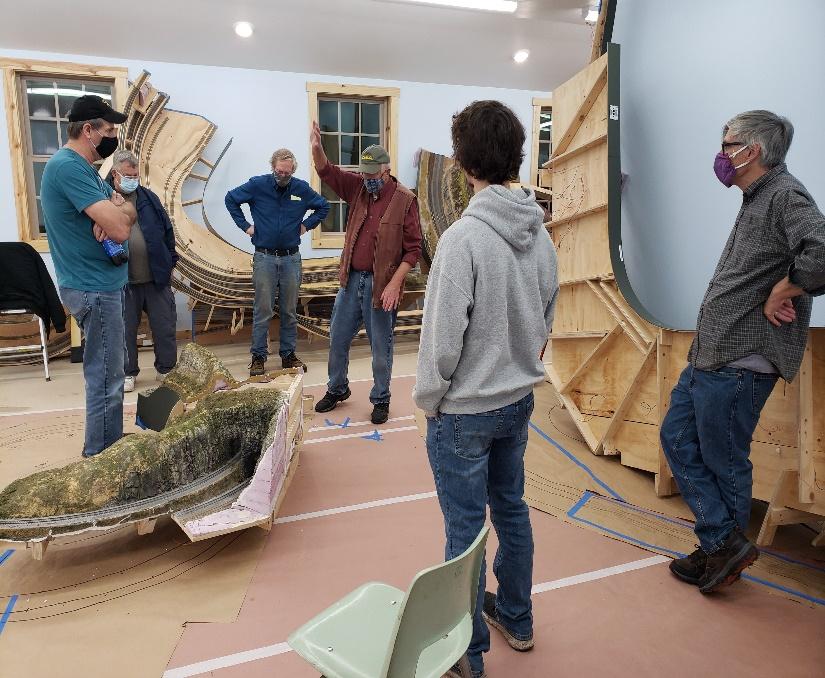
Doug contemplates the laws of  physics and the mass of this piece. Yes, it needs to go up on the L girders 

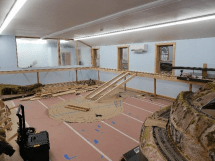
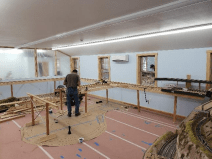
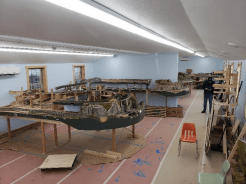
After 3 months of actual demolition, hauling and reconstruction, all major pieces of the layout are now in place. They are also in pretty much the same relative positions as they  were in the old room. We have some areas that need to be extended and some areas that  need to be slightly reconfigured to make angles match. The basic plan remains as it was. 

Our basic priority was to get the lower level mainline chunks set in place. These served to define locations for the upper level main and it remained fundamentally the same.  The logging line had to be the third priority and it will change a bit probably for the better – longer. With these pieces in place it became apparent that the clubs wishes for more  switching can certainly be accommodated. 

With major chunks of layout on the L girders there are several large pieces of upper level main that remain unattached. These pieces will have the risers removed so we just have subroadbed (plywood), roadbed (cork) and track left. We can take these track-boards and knit them together to create attributes of the former layout. Some new construction will be necessary as in new stringers and risers. When this is complete,  we will do the same with the logging line.  This requires that we keep the upper level main and logging line in mind as we set the lower level pieces in their final locations so there’s room for all of it. 


Doug applies Big Ike’s 4th law — Shove really hard

Several areas of total reconstruction exist. The helix area outside of Philomath that gets us to the upper level, the Eagle Cove extension (leading to a paper mill?),  staging/set-up yard, and 35 feet of new  switching area. We will be arranging to get input regarding club wishes regarding these  areas although many ideas have been put forward already. Lack of specific direction will not, however, impede progress on the rest of the layout. There’s much work to be done before switching areas need to be  addressed. 

Next steps involve creating custom cut parts to knit major sections together.  This will involve some precision work and  be a bit tedious. We will probably start with the big yard in the north room and work our way south to the yet to be  defined helix area.  

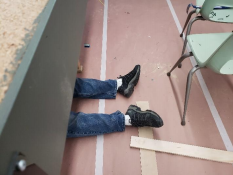
Doug responds appropriately and collapses as Jerry documents the arduous task

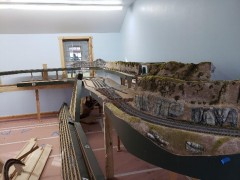
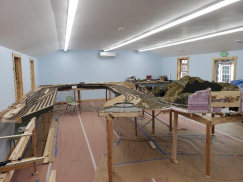
The north room – Eagle Point (center) and main lines rounding the shear wall (lower  left). Big yard in background

 The South room — old Corvallis along  shear wall (rear) and Philomath blob

Rounding the Shear Wall

12/1/20

Your construction crew had a conversation about response options to virus numbers across the state. We decided to continue working in small groups, wear masks, wash our hands, and use sanitizer. Normal workdays are still Monday and Tuesday 9-1 PM, however individuals can come and work at any time as long as work follows our general plan. In this manner we hope to continue making progress while keeping safe. We all recognize the risk and hope to minimize it using this format.

This week we rounded the shear wall with George, Gene, and Doug setting L girders along the walls of the south room. George did the bulk of the work and Doug and Gene provided help as needed. Today we all got together and hefted Corvallis in place. It fit nicely with very little modification. 

George works on south room L girders as Doug picks up the last pieces of  what was once a large pile of cut-offs.

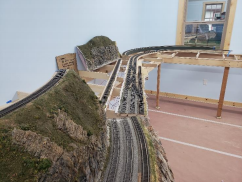
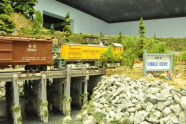
Doug has concentrated efforts in Eagle Cove and Eagle Point and it shows. The area behind the roundhouse has been framed in and the sawmill has moved into that area. Track re-alignment is developing around Eagle Point and will be spectacular when complete.   It will be clinging to a cliff, jumping across a small bay on trestlework and finally landing on its original alignment near where the old sawmill  used to be. 

I framed in the area where the paper mill and chip yard will be. While working on that I was able to provide access to a window and set up for Eddyville to be installed. This framing will support lower level access to Red Rock as well as upper level access to the staging yard. This framing had to be all new because it didn’t exist on the old layout.   Another big effort today was picking up all the small chunks of plywood that develop during a significant rebuild like this. We had a substantial pile in the middle of the south room and also a large box next to the chop saw. We dumped it into my truck and I was going to take it to the burn pile at the ranch. After considering the number of screws and nails in this stuff, I decided to take it to Coffin Butte Landfill. This will reduce the number of holes in the horses feet and the amount of time I’d have to spend pulling them out and treating them. It also enhances domestic tranquility between the barn boss and myself. 

The east end of Corvallis is now in place. Notice the gap between the two layout  chunks. This will be filled in once we know the  exact location of the Corvallis chunk.

A word about setting chunks of the old layout in place is appropriate here. We carefully calculate where L girders will be needed to support our layout chunks and then install these girders complete with spacers and stabilizing braces. These are then carefully leveled with reference to the perimeter L girder on the wall. The layout chunk is then lifted into place and aligned. Most times this alignment process requires  tweaking the ends of chunks to change angles or add/subtract length. Once this is complete we screw from the L girder up into stringers of the layout chunk. 

There was once a wall on this end of Eagle Point but Doug and Gene hatched up a pretty nice scenic detail to round off the end of this peninsula.

A closer view of the roundhouse back and new location for sawmill. This area did not exist on the old layout as there was a wall here. That’s why the back wall of the roundhouse was left off.

Framing for the paper mill and chip yard.  Blank area to the right of new framing will be the 43” aisle in front of Red Rock and staging yard. There is an access hatch right in front of the window.


Making Progress

11/16/20

Today was a busy work session as we moved forward on several fronts.  During lunch the crew discussed the upcoming restrictions on work, holidays and their impact on work sessions. It was decided to hold off on formal work sessions for the next two weeks. Individuals can come in and work on special projects. For example, Doug wants to continue work on Eagle Cove and Eagle Point and Gene wants to work in the old clubhouse dissecting Digitrax electronics for salvageable parts. Others may want to keep moving on their own projects and nothing will preclude those efforts. We’ll keep you posted on work sessions during December and into January.

Doug and Gene use a fascia board to determine the outside edge of Eagle Point.  George works on the destruction of Ashar.

Doug has some exciting ideas about the resurrection of Eagle Cove including extending the waterfront northward a few feet, abandoning the existing track thru a tunnel and replacing it with track on trestlework as it skirts a headland by running out into the bay.

Gene worked on fasteners to hold yard sections to the L girders thus stiffening the whole structure nicely. He also planned the framing around the existing roundhouse and how to modify it to blend with Doug’s Eagle Point. 

George sets stringers for the new construction between Toledo Yard and Ashar along the west wall. Notice the string line along the end of the stringers, This insures a straight fascia. Also, stringers have been notched in case we want to lower the mill area (or whatever  industry fits in this place, if any) plywood scraps and cardboard. Notice a staging yard at this level allows sight lines clear  to the back of the lower switching area. This yard can be supported on brackets with no structure below.

George completed the stringers along the shear wall and over to the entrance to Toledo Yard. He also carefully disassembled the Ashar/Scott’s Mill section so we could use the trackboards on new framing. Trackboards include the ¾” plywood subroadbed, cork  roadbed, and flextrack . We lined out how these pieces would have to be modified to accommodate new dimensions and planned to use most of the available track and switches. 

The Ashar crossover module sets close to it’s final alignment along the shear wall.  Curved track in the foreground will be trimmed  to an alignment angle with Ashar. Upper track  in this figure is the upper mainline. 

This individual claims he was, in fact, working and not taking a nap! Guess who.

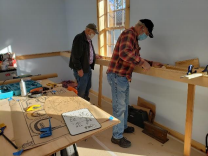
Jerry worked on south room L girder layout, north wall deck separation and assisted others as required. We built mock-ups of north wall sections to determine separation requirements in one to one, three dimensional models.  We built both 5 track (existing) and 4 track (modified) staging yard sections in order to check sight lines and accessibility.  

Where There is Smoke, There Might be Fire

11/10/20

Work continues on the layout rebuild as we set L girders, add legs as appropriate, figure grades and place additional layout chunks in place. This week we made good progress as McDonalds on 9th street came to know our order before we placed it. Our group has thinned out a bit as Covid facts weigh in and some members respond to these concerns. We respect these responses and will continue to work as virus numbers and Adair Village policy allows. Please understand that County responses to the pandemic may require all of us to suspend work. We do have a plan “B” however, and that is to do pre-cuts (pieces fabricated in home shops and brought to the layout for later installation) in  our home shops such that they will be ready when things start up again. We haven’t heard  about any shut downs but we are ready. 
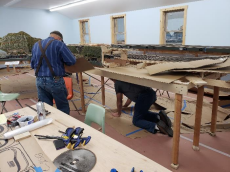
Final alignment process on the Eagle Cove/Eagle point section 

Doug and Gene worked for two days to complete framing below Eagle Cove and Eagle Point. Additionally they attached the harbor, helix, and turntable yard chunks together to form one large layout piece. This is a complex process made easier by nicely leveled L and T girders. Some adjustments were necessary but layout joints are looking good with only minimal – less than 1/16”—adjustments required for smooth track. Congrats to these two guys who are pioneering reassembly processes. As they sharpen their skills we will develop many more opportunities for them to demonstrate their expertise. 

Lonnie, Vic, and George assembled additional L girders for use in the south room. They  had quite a process going on as they clamped, glued, air nailed and screwed them together.  The original L girders were getting pretty well picked thru as we used them up in the north room. 

We had to hold an impromptu engineering meeting Monday morning regarding an  gradient dilemma. This had to do with the difference in floor levels of almost 6”, between the main room and the yard area in the old building. When we rebuilt the layout 8 years ago we accommodated this difference with clever grades on the mainline and a reduced height at Eddyville. Most folks didn’t notice these adjustments. Monday morning these anomalies bit us in the butt. Lively discussion ensued. 

The problem was defined as a difference of about 3 inches in the framing leading up to  Eddyville. Leaving the yard and going up the Eagle Cove helix was going to require an added rise of over 3” defined as an additional 15 feet of run at 1.7 percent. Several options were discussed including cutting the top off Eagle Mountain, adding another circle to the helix, and  replacing the peak. Doug Taylor, builder of the original Eagle Mountain, came close to apoplexy as he almost swallowed his mask and passed out from hyperventilation. 9-1-1 was considered but other options were quickly suggested and color soon returned to Doug’s face. The L girder he had ahold of , however, will forever have his fingerprints embossed in it. 

The selected option included continuing the 1.7% grade for another 15 feet into Eddyville. This requires one leg of the staging track wye to be on a grade but the math shows this can be  reduced to 1.3% or less. Discussion regarding the need to back up the wye with a long train and subsequent problems with backing on a curve and grade made obvious the need for the staging  yard entrance to be bi-directional. It can now be entered either from the east or west and crossovers and a turntable in the yard allow for reversing trains. A side benefit is additional clearance between the upper staging area and lower switching area. 
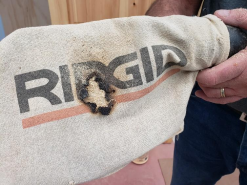
Grievous damage as the result of the  blaze

On Tuesday, excitement was ignited among the group by a fire in the shop. The conflagration started in the chop sawdust bag. It was immediately reported by George and quickly dealt with by him running outside in the rain. Other members of the crew attempted to evacuate the building but we’re pretty old and all were laying under the layout. This resulted in a winning scene for America’s  Funniest Home Video as 3 old guys tried to gain an upright posture suitable for the evacuation. They grabbed anything to  assist in standing up including each other yielding a rather savage scene. Just as they all got to an upright stance satisfactory for evacuation, George came back having gained the upper hand in controlling the blaze. One member, who got up quickly, was seen leaving the scene but later returned with a package of hotdogs from the little store. There were no injuries or damage to the building. The picture above pretty clearly shows damage sustained by equipment. 

Subsequent investigation yielded a cause for the incident. A member was using the chop saw,  inadvertently nicked a hardened screw, the resulting spark flew into the sawdust bag , slowly smoldered amidst the dried sawdust, finally ignited and blazed forth in all its fury right in front of poor George. The investigation also showed that George reacted well by reporting the incident to Jerry while holding the bag. Jerry, standing next to a fire extinguisher and being a Cajun, sent George somewhere else – outside.
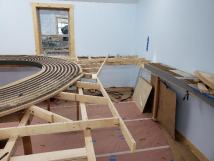
The Blob

11/3/20

Today the crew was pretty focused on technical issues of leveling and aligning. We did however, have time to set the last piece of the Eagle Cove peninsula and begin engineering the  Corvallis “blob” around the shear wall. 


 Eagle Cove peninsula is now open  where there once was a wall. Pink foam was up against the wall.

Gene, Doug, Larry and Jerry worked on completing the Eagle Cove peninsula.  This involved some L girder trickery – T girders, set down L girder, and cantilevered stringers. This was complicated by the fact that Doug had built framing under Eagle Cove strong enough to support cement mixer trucks – 2 of them . . . loaded . . . side by side! This of course had to be deconstructed and then re-constructed for the current need. Doug builds ‘em strong. 

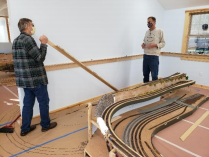
Randy and Vic took on the “blob”. job” and reverse engineered it to fit the wall. This meant setting the chunk down on wheels so it could be moved around easily and then cutting and fitting until it lined up. Several things had to be taken  into account throughout the process including two aisleways at 44” minimum,  alignment with the Ashar crossovers and  alignment with the actual town of Corvallis  section. Careful measurements from the  west wall to the end of the shear wall were necessary to insure Corvallis would fit. This  process proceeded with the “blob” on the floor and L girders were built above it.  

Serious consideration of the many variables involved in cutting and fitting the Corvallis blob around the shear wall

Vic and Randy cut and measure 

Placing Pieces on Girders

11/2/20

As work sessions go, today was pivotal. We set the first 4 sections of the layout up on L girders and aligned them. This was very exciting. These sections looked just as good on the new L girders as they did on the other ones in the old room.  Sections placed today included all 3 pieces of the main yard (old Albany and Toledo) and Eagle Cove. Minor modifications had to be made to the  yard sections resulting in a pie shaped section being removed. This allowed much more room in the operator’s bay, a larger access, and both sides being almost parallel. 

Please understand these sections are merely placed on the L girders. NO track or electrical has been hooked up. This allows for final tweaks after all north room sections are set in place. Tomorrow we hope to set several more sections. 

Doug cuts the proper angle on a yard section

Larry once again proves he is the fastest vacuum cleaner guy in the world as he keeps the place picked up. Picture shows the old Albany yard being prepared

Moving at a Brisk Pace and Under Budget

10/30/20

Friday morning Gene, Doug, Larry and Lonnie went down  to the club to hold a few L girders while Jerry thought about where they should go. One thing led to another and we ended up  building and leveling the L girder system for the center peninsula in the north layout room. It came out really well and is now ready to accept several large chunks of layout including the old Albany  yard, Old Toledo yard, the big horse shoe that connects them and the Eagle Cove module.  With a bit more work we can add L girders for the Eagle Cove helix and set that up. Having the helix in place will define where the shear wall turnback chunk goes (it used  to be between Corvallis and Scott’s Mill). With this curved piece set we can begin framing the  connection along the shear wall and on into the new  Toledo yard. 

Larry keeps everyone on the  level with a laser and demanding  exactitude. 

We have brackets for the double deck north wall staging yard and switching area. Once these are installed we can modify and move the old staging  yard and set it in place. This will require some cutting and framing as defined by bracket location.   Base L girders are in place for the lower switching area along the north and east walls and this is ready  for the installation of Red Rock along with additional framing.  

Some re-construction is defined by existing  chunks of layout, however, additional pieces need  to be framed in to connect the chunks.  Membership can have a big say in how these pieces are built and what function they will serve. The  November business meeting will be critical for  those of you who want to help define the direction of the layout since footprints of these “new” pieces  will be pretty well defined. Within limits, the crew can accommodate wishes of members at this point because as we go along, footprints, grades, and  subsequent track layout become increasingly  defined. 

Doug wants to know how many  times he has to measure this thing and  Gene quips that he’s already cut it off  twice and it’s still too short!

We find ourselves focused on the north room because, by getting certain sections off  the floor in the south room and onto girders in  the north room, additional floor space is freed  up for construction to continue around the  corner.  For the financially minded folks  reconstruction has proceeded at a brisk pace and is under budget. Purchases of plywood, fasteners, glue, markers, band-aids for Doug, and other incidentals have been frugal and focused. Several members have  stepped up with their own funds for materials and for that we are grateful. Additionally, a chop saw was borrowed by Doug (the owner knew he had taken it), Larry provided a table  saw and vacuum, and crew members have brought their own tools. El Presidente alluded to the need for reimbursements at the business meeting and, that too would be much appreciated. 

That’s about it for this report. Monday  we will start installing big chunks. We need  beef to move these things so any help would  be much appreciated. Work will probably start  in earnest about 9:30 AM. The project is moving forward ahead of schedule and under  budget. Good work one and all. 

L-Girder Thievery!

10/27/20

Progress on the CSME layout re-build is moving  right along. The planning phase is coming to a close and real construction has begun. This Monday and today the crew ran amuck with L girders as actual  cutting and assembly began.  

A small crew met at Gene’s shop and ripped and assembled new L girders to be used for the  critical perimeter locations. These perimeter L girders  were carefully placed along the walls and they became  the basis for all elevations on the finished layout. To accurately place these critical pieces,  Grinnel brought his laser level and led a crew who placed level reference marks around the  walls. Seems like they said total discrepancy from south wall to north wall, a distance of 80  feet, was less than ¼”. Pretty close for model railroad work. 

Using these reference marks, perimeter L girders have been fixed to the walls in the  north room. These are the new L girders assembled in Gene’s shop because they are all  reference points. These are nice to work with because they are not all hacked up with screw  holes and saw cuts everywhere. They have become a premium during this phase of  construction. In fact, L girder theft is becoming more and more commonplace as “good” girders are used up leaving only the leftovers. Crews have to guard their girders until installation.  Photo evidence of this pilferage exists!!

Photo evidence of L Girder thievery exists. George complained vehemently but to no avail.  The perpetrators continued on with their skullduggery.

As we set girders this morning an engineering problem became apparent. It had to  do with the north wall double deck portion of the layout. We have plans to create a lower level switching area and an upper level staging yard (Albany) along this wall. Simple oversight created this dilemma stemming from the floor level difference in the old layout room. This difference resulted in 7” of vertical clearance between the Toledo Yard and Eddyville instead of 12” which exists everywhere else. 7” is not enough vertical clearance to create an operational area below,  therefore, we called an immediate “engineering  meeting” with all hands on deck. Within a few  short minutes we had a number of options for  mitigation. After consideration of these changes,  it was decided to implement several of them including raising Eddyville taking care to not exceed 1.7% grades, creating tapered framing under the existing staging yard sections, hanging the yards using robust shelf hangers so no vertical supports are required and reducing the  width of Albany by 1 or 2 tracks. 

These changes will require additional work to create modifications, however the crew is up  to it. We feel confident that, even with the  required compromises, switching and staging  functions can be preserved along the north wall. This points out one of the beauties of ¾” plywood  construction – it can handle these additional  stresses.

Re-Assembly

10/21/20

Several folks showed up to talk about re-assembly of the layout on Wednesday  evening including: Cody, Grinnell, Lonnie,  George, Larry, Gene, and Jerry. After reviewing the 1:1 drawings we talked about  the railroad track plan both from an operational and open house perspective.  These discussions yielded several modifications and clarifications that will make this club layout fit the needs of members. It was a very  positive and productive discussion.  

This free flowing exchange of ideas showed that, in several areas of the layout, pieces  can be re-assembled using the present track plan with an eye toward later modifications that  will provide even more enjoyment for members. It also showed that we can begin reassembly  on Monday and leave room for these changes to occur. Since we are merely constructing the L  girder substructure with layout chunks sitting atop them, none of these ideas will be set in  stone until after the membership has had a chance to review them. Thus, the business meeting  scheduled for 11/4 will be most important. 

We talked about a major change to the operations of the layout to more closely emulate  a point to point run from the SP/UP/SP&S interchange at Albany out to the coast at Toledo. This can be accomplished in a most efficient way and can include provisions for “round  and round” train running as well. These concepts can be included in the present track plan. 

We talked about using the existing staging yard for both open house setup/takedown of  trains and operating session gateway/interchange switching. Most of these functions can be  provided by the existing yard with a modification to the entrance and construction of a new bi directional wye coming from Eddyville. Other track changes can be made later and we can  more clearly show these adjustments during the business meeting. 

A scenery discussion was held regarding modifications to the helix next to Eagle Cove. Years ago there was a tidewater trestle running from Toledo out toward Yaquina Bay.  Doug Taylor wants to take this on as a major scenic element. During the re-build all we have to  do is set up layout chunks in such a manner as to leave space for this to happen. As it turns out,  this will be quite easy to do.  

Discussions were held regarding the placement of the first peninsula wrapping around  the shear wall and what tracks will penetrate the wall. Two different concepts emerged and we  will refer that to the membership.

A lively brainstorming session was held regarding the  south helix between what we have called lower level  Philomath and upper level Blodgett. The group came to  consensus about recommending to the membership  certain aspects of the helix including: building a new  single track helix, making it partially hidden and partially  open track, using a “herniated helix” rather than a  concentric set of circles, including some windows into  tunnel areas, providing grade reduction by adding an  additional loop or extending the grade into Philomath  and/or Blodgett and keeping the reverse loop.  Membership will have to weigh in on these concepts. 

There are about 4 workdays between now and  the business meeting. These sessions will see big  changes to the club as L girders / legs are set and large  chunks of railroad put up on the frame. These chunks  will, for the most part, still be  moveable as they sit loosely atop the L  girders. We can’t screw them into  place until membership approves.  Exciting times at CSME!! Stop  by if you have a chance. We work M  and T from 9-1. There are lots of jobs available including “heavy  construction” and “sit down” types of  work. As a side benefit we attempt to  have highly structured, intelligent,  creative and meaningful discussions  during lunch – it hasn’t happened yet